


Simplifying SEO: The 6 Core Metrics You Need to Know
- Jun 4, 2017
- 6 min read
You have probably heard rumors of this Search Engine Optimization (SEO) service which is crucial to the success of every business with a website. Do you know what SEO is? If not, don’t fret. There are many people, even marketers, who are still trying to wrap their heads around the science of it. As ambiguous and challenging SEO is, there is reason and a process to the madness.
You have probably heard rumors of this Search Engine Optimization (SEO) service which is crucial to the success of every business with a website. Do you know what SEO is? If not, don’t fret. There are many people, even marketers, who are still trying to wrap their heads around the science of it. As ambiguous and challenging SEO is, there is reason and a process to the madness.
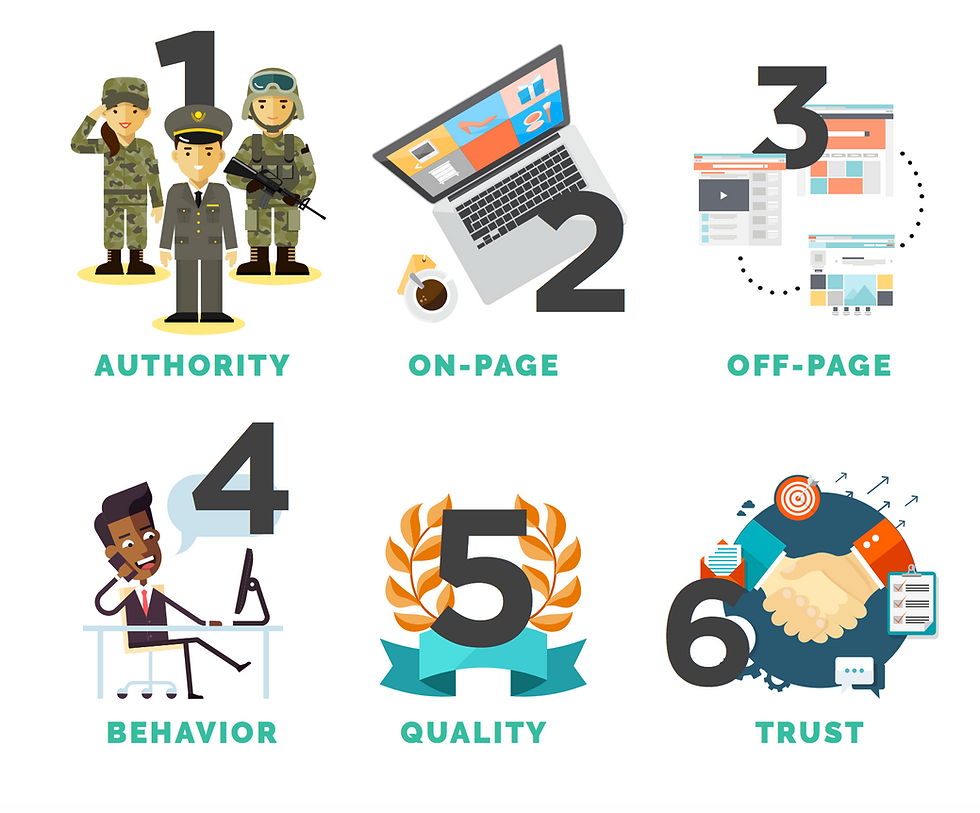
Here are the six core metrics you need to know about SEO.
AUTHORITY
Authority is known internally to Google as PageRank, which serves as the primary authority algorithm. Released in 1998, PageRank was named after Larry Page, one of the founders of Google. PageRank functions like a link voting system among pages to determine which pages have the highest relevance. Google not only looks at the quantity of the links pointing to a page, but also at the quality of these links.
PageRank is difficult to influence directly, as one of the primary metrics is website Age. Moreover, Google emphasizes that PageRank is just one of the many metrics for web rankings. Recently, Google removed PageRank from public access to prevent webmasters from manipulating it.
Best Practices
Don’t optimize for this metric—you cannot manipulate PageRank.
Leverage Authority only if your client’s website has it.
Improve page elements: site speed, headers, Meta tags, content quality, rich media, trust signals, social sharing buttons, calls to action, and navigation.
2. ON-PAGE
On-page is the first metric of search. Foundationally known as the LDA (Latent Dirichlet Allocation), this serves as the core of all search engines. As opposed to Latent Semantic Indexing (LSI), LDA is the literal and basic element of the On-page metric. It is the reason content will always be king—search engines will figure out what the website is talking about based on how the website talks about it.
When it comes to On-page, most SEO specialists would agree that the essential factors that affect ranking include an optimized title and header tags, a good keyword list, internal linking, and high-quality content. By implementing the right changes to on-page elements, a website can rank well on the search results pages and provide a better user experience to visitors.
Best Practices
Optimize Meta titles by limiting it to 68 characters with the keyword and brand name of the website.
Meta description should encourage higher click-through.
Wrap your title using the H1 tag and subheadings using the H2-H6 tags.
Use bullets or numbered lists to make content scannable and easier to read.
Keywords should be in the top 100 words of the body content.
Insert multiple content formats, such as images and videos.
Add internal links to the appropriate pages.
Link to authority sites, but don’t overdo it— 2-4 times are enough.
Use LSI keywords throughout the content.
Resize the images before uploading and insert the target keyword in file name and alt text.
Publish long-form content (1,500 words +) to provide more indepth, valuable information to visitors.
3. OFF-PAGE
Off-page is a Google-invented metric that focuses on building quality backlinks. Larry Page invented the concept of backlinks to view the relevance of a website based on the links that point to it. This metric involves all external factors that influence the performance or ranking of a page or website—this is opposed to On-page, which focuses on internal parts of a page or website that influence its rankings. Think of Off-page as online chatter. This metric uses backlinks as a measurement of how many people talk about the website online. The more buzz you create, the more popular the site will be. Nonetheless, off-page is not the core of what makes a website rank; it is only 1/6 of an entire SEO strategy.
Best Practices
Improve your content marketing strategy.
Create compelling content that can be cited as a resource.
Get your client’s business on relevant business listings online, such as Yelp and Yellow Pages.
Get published on high-authority sites relevant to your client’s niche.
Develop a strategy for social media.
Create an engaging title and description with target keywords when optimizing videos for YouTube.
Improve your client’s brand mentions—your client’s digital footprint should refer to their name than it does by their keyword.
4. BEHAVIOR
Search engines are turning to user intent to determine which websites deliver relevant content to visitors, which turns us to this specific metric group: Behavior. Unlike Authority, Behavior is a metric that you can control if you have Analytics. The Behavior metric tells you if your SEO is targeting the right audience. User behavior data provide search engines insights on how visitors engage a website when they are searching. These metrics include:
VISITS The number of times a website gets accessed by search users. BOUNCE One-page sessions when visitors land on a page and leave. EXITS It indicates how often users exit from a page or set of pages when they view the website. SESSIONS The period of time a user is actively engaged with your website, app, etc. All usage data (Screen Views, Events, Ecommerce, and others) is associated with a session. REPEATS The number of users with two or more visits during a specific reporting period. UNIQUES The number of individual users visiting a site over a specific reporting period. CTR The percentage of users viewing a page, email, or ad through a hypertext link.
Best Practices
Plan your site architecture with user experience engineering as the foundation.
Make your clicks shallow—visitors usually don’t go past the third click.
Showcase your client’s brand name and value proposition when optimizing the meta data.
Change the layout of your site based on how users are behaving.
Look for opportunities based on the number of impressions vs the number of clicks.
Change the layout of your site based on how users are behaving.
Look for opportunities based on the number of impressions vs the number of clicks.
5. QUALITY
The Quality metric is the on-page regulating element of the Google algorithm. This augments or depreciates your on-page score. Along with Google Panda, this does the incremental increases and decreases across your client’s website. You can leverage this metric through the following elements:
CONTENT ORIGINALITY Presenting unique information to users MOBILITY Providing a mobileresponsive website SOCIABILITY Including social sharing buttons SECURITY Adding a security certificate USER FRIENDLINESS Improving the usability of the website CONTENT QUALITY Providing relevant, coherent information TRUST SIGNALS ON-SITE Including credibility badges on the website
Best Practices
Apply an HTTPS certificate to your client’s site.
Build your client’s site using a mobile-friendly framework.
Use modern code (HTML5 and CSS3) and check for errors.
Include social sharing buttons above the fold to leverage social
signals.
Allow comments to encourage interaction among visitors, but beware of spam by activating plugins like Akismet.
Implement rich media like images and videos for added interaction with visitors.
Apply trust signals and badges.
Link to reviews.
Use Google PageSpeed Insights to check site speed and view recommendations.
Use Rich snippets and markup your content items to increase user engagement.
Create a sitemap to highlight the important pages on the website navigation and help search engines understand your
site structure for faster crawling.
6.TRUST
The Trust metric is the Off-Page regulating element of the Google algorithm. Also known as Google Penguin, this focuses on a website’s backlink profile and digital footprint. Organic, relevant link building is the most important element to look at when it comes to the Trust metric. Like the Authority metric, Trust is a metric that you cannot manipulate. Nonetheless, many SEO specialists perceive that Trust has a big role in the success of a website from a search perspective.
Best Practices
Don’t optimize for this metric alone.
Don’t hire cheap SEO services—only trust the experts.
Build thought leadership to leverage expertise.
CONCLUSION
SEO metrics provide a form of validation to your work and shows the growth opportunities that you can integrate to your website. These lay out the foundation for your SEO strategies and provide context behind the numbers and results.
Comments